

Founder and President of Regentropfen University College, Rev. Fr. Dr. Moses Asaah Awinongya, says his experience establishing the institution has strengthened his conviction that Ghana needs more universities capable of responding directly to the country’s development needs.
Reflecting on the 10 years of Regentropfen University College, Rev. Fr. Awinongya said he would not hesitate to establish more institutions if he had the financial resources.
“If I have financial resources and the kind of workforce like Moses, one of my employees, I mean, I have 10 of them. I would put up 10 universities,” he said.
The comment forms part of his broader argument that expanding tertiary education is necessary to address the development gap in Ghana.
Speaking on A1 Radio, monitored by BolgaFM, he noted that the decision to establish Regentropfen was motivated by the belief that young people in the Upper East needed greater access to higher education and professional training without necessarily having to leave the region.
He says the response from students has reinforced that conviction.
Many students, he noted, arrive at the institution with limited opportunities but leave with a stronger sense of direction and hope for the future.
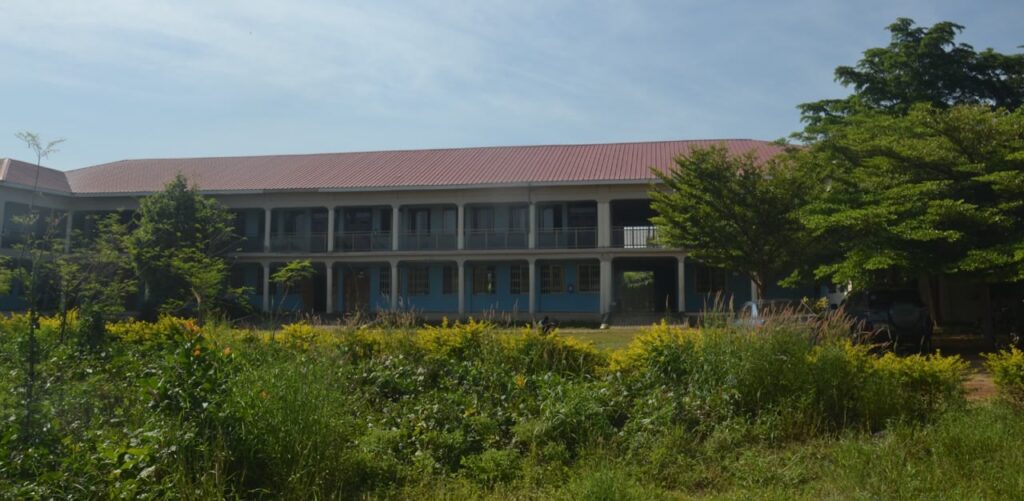
“For us, if you’re not making money, what is keeping us on? It is the joy in the faces of the young people,” he said.
The founder’s vision for expansion, however, is not limited to increasing the physical size of Regentropfen.
He wants the institution to develop into a major centre for teaching, research and professional development that can help retain talent in the Upper East Region.
He says the region has produced professionals who have travelled elsewhere to build their careers and acquire experience, but believes some of them should eventually return to contribute to development at home.
“It is good that we go out and we get experience, but we also have to come back home to build,” he said.
Rev. Fr. Awinongya argues that local development cannot depend indefinitely on external expertise.
He says communities must increasingly develop institutions and human resources capable of identifying and solving their own problems.
That thinking is also behind the university’s efforts to attract academics from the region and beyond.
He cited an example of a young professional from Namoo who offered to lecture for the institution without payment and another relative in the United States who is a professor.
He says such interest demonstrates the potential for a stronger academic community in the region if the necessary institutions and infrastructure are created.
The ultimate ambition, he says, is to make the Upper East Region a magnet for education, research and investment.
He believes research organisations and companies operating in the region should increasingly consider local tertiary institutions when looking for partners to undertake studies on issues affecting the North.
The university is also positioning collaboration as a central part of its growth strategy.
Rather than seeing institutions such as Bolgatanga Technical University and the University of Technology and Applied Sciences solely as competitors, he wants them to explore joint research, investment and academic opportunities.
He says such collaboration could include joint degrees and other programmes that would broaden opportunities for students.
“If we now see what are the common things that we can do in terms of research collaborations, in terms of investment and stuff like that, so that we can grow together,” he said.
Beyond academic programmes, Regentropfen is also seeking to demonstrate its contribution through practical interventions.
As part of its 10th anniversary activities, the Regentropfen family is undertaking a project at Bongo Hospital, which the founder describes as a concrete contribution to its immediate community.
The institution is also organising a skills and trade fair where students will interact with business executives and pitch business ideas.
Selected students are expected to receive seed funding and guidance to develop their businesses.
For Rev. Fr. Awinongya, these initiatives reflect a broader philosophy that universities should not operate as isolated academic institutions.
They should contribute directly to the economic and social development of their communities.
He also wants the university to grow into an independent institution with stronger faculties and experienced professors, although he says growth must be matched by infrastructure and academic capacity.
The university is therefore approaching expansion cautiously, particularly because rapid growth without adequate facilities and staff could affect the quality of training.
But the long-term ambition remains significant.
Rev. Fr. Awinongya believes that if more institutions are deliberately created to fill identified gaps in education, skills and research, the cumulative effect can stimulate development beyond the institutions themselves.
His argument is that universities create more than graduates: they can generate businesses, research, professional networks, investment and solutions to local problems.
And it is this broader development impact that he says keeps him committed to the university after a decade.
He maintains that if resources become available, his ambition would extend far beyond the existing institution because, in his view, building more universities that respond to Ghana’s development needs would create more opportunities for young people and contribute to national growth.
Source: Bolgafmonline.com| 102.7 MHz| Bolgatanga
